
Commercial HVAC
Commercial HVAC Maintenance in South Gate, CA
If you manage a building, commercial HVAC maintenance in South Gate gives you two things: fewer tenant complaints and a paper trail. Planned visits catch failing parts before summer, and dated records show what was done on each unit. Call Proair to talk through what your building needs.
- CSLB C-20 #776028
- 4.8 from 16 Google reviews
- Shop in USA Business Park
- Open Mon to Sat, 9 to 5
What building owners and managers are answerable for
Your exposure starts with the lease and ends with the equipment’s records. Before setting a schedule, work out who owns each duty. South Gate’s retail and light industrial space along Firestone Boulevard and Atlantic Avenue often mixes owner-run and tenant-run units on the same roof.
- Who pays for filters, tune-ups and major repairs, according to each lease.
- Who holds the warranty on each unit, and what it requires.
- Which units serve which suites, by tag number.
- Who may approve repairs, and up to what amount.
- How tenants report a comfort problem, and who logs it.
Skipped maintenance rarely shows up right away. It tends to show up late in summer, after a clogged filter has starved a unit for months. South Gate’s cooling demand runs into October, so the risk does not end in August.
Watch for repeat complaints from one suite, filters caked at every change and refrigerant added twice in a year.
Which refrigerant records do you need to keep?
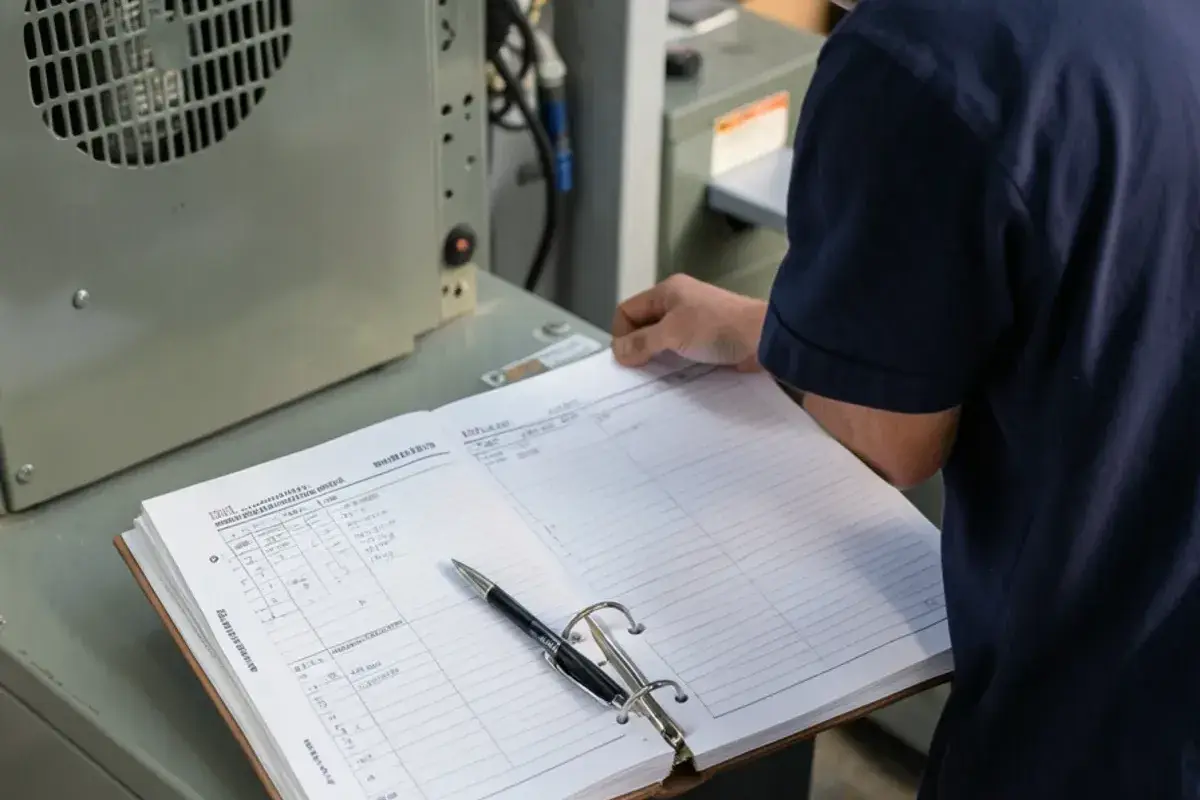
It depends on the charge size and equipment type, so start with the nameplate on each unit. These are the main rules we would check as of October 2026.
| Rule | Applies to | What it asks of the owner |
|---|---|---|
| EPA 40 CFR Part 84 | 15 pounds or more of HFC or certain substitutes; residential and light commercial AC is exempt | Leak rate math after adding refrigerant; comfort cooling threshold of 10%; repairs within 30 days; records for three years |
| South Coast AQMD Rule 1415 | Non-residential AC above 50 pounds, per circuit | Plan filed every two years, annual leak inspection, leaks fixed within 14 days, records on site for five years per the rule text |
| CARB Refrigerant Management Program | Stationary refrigeration above 50 pounds; AC is not registered here | Leak checks, repairs within 14 days, service records for five years |
Read the first row closely. EPA’s exemption covers equipment for rooms, homes and small commercial buildings, while chillers and certain variable refrigerant flow systems are not in that group. If you are unsure where a large rooftop unit lands, ask EPA or your compliance advisor. The rules are still shifting, so check for updates each year.
Even on a small unit, keep the tickets. A log of refrigerant added is the easiest way to spot a slow leak. Sites with large walk-in coolers or cold storage should also read the CARB row, since that equipment is refrigeration rather than air conditioning.
Title 24 and your records
Routine work stays outside the Energy Code: the CEC treats filter and belt changes as minor maintenance. Replacement does, and keeping past NRCC forms and acceptance certificates saves time. Ducts documented as previously sealed may be excused from a repeat sealing requirement, which is one more reason to keep the file.
Cal/OSHA’s annual inspection record
Cal/OSHA’s Title 8 Section 5142 covers mechanical HVAC systems that provide minimum building ventilation. It calls for inspection at least annually, written records showing the name, date, findings and actions, and five years of retention, with records produced within 48 hours of a proper request. Confirm how it applies to your building. If a finding leads to new equipment, the City of South Gate requires permits for mechanical improvements, so call Building and Safety at (323) 563-9549.
Commercial HVAC maintenance in South Gate: what each season covers
A common pattern is two full visits a year, with filter changes in between. Your site may need more. These are typical items, not fixed terms, so build your schedule around the building.
| When | Focus | Typical tasks |
|---|---|---|
| Spring | Cooling | Coils, pressures, contactors, drains, belts |
| Early summer | Filters | Filter change, drain flush, quick airflow check |
| Fall | Heating | Ignition, burners, heat exchanger, flue, economizer |
| Winter | Filters | Filter change, thermostat schedule review |
- Filters logged by unit tag, with size and MERV.
- Coil, drain and belt condition noted.
- Electrical readings and refrigerant pressures recorded.
- Heat section and economizer tested before winter.
- Needed repairs listed and priced before work starts.
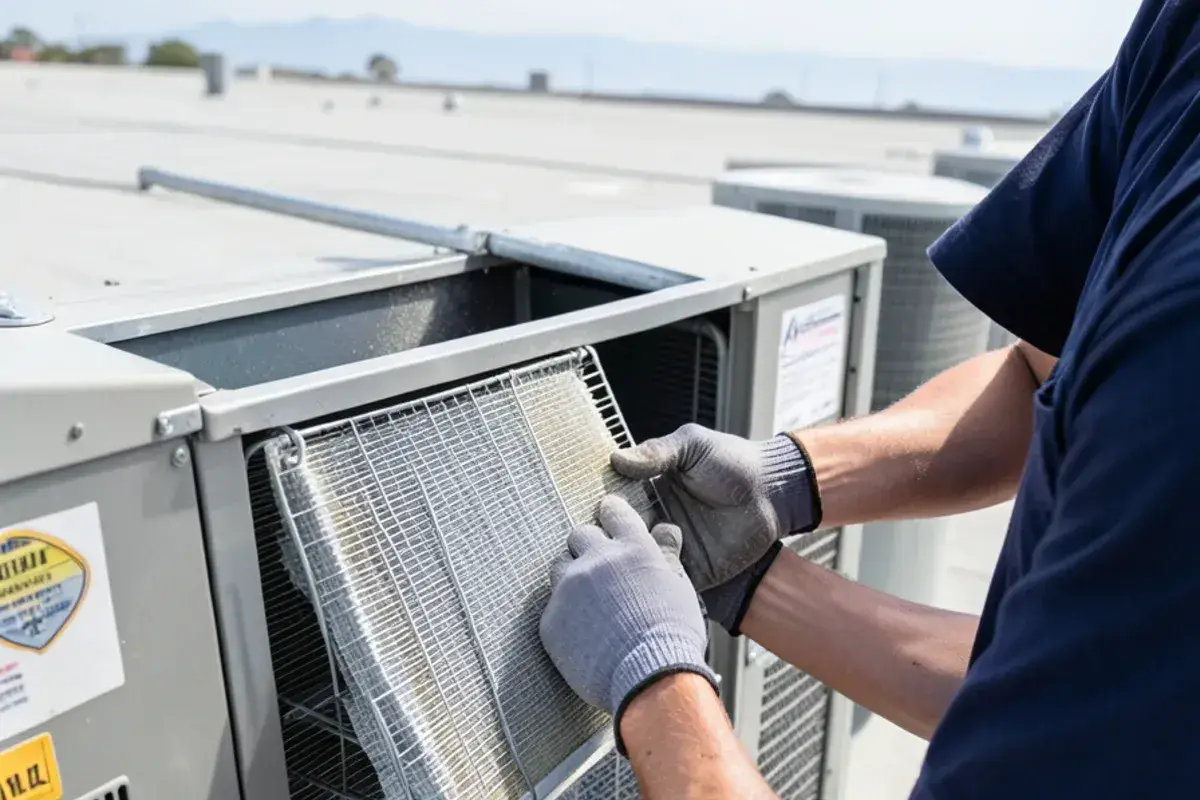
Adjust for the tenant. A restaurant’s grease load calls for shorter coil and filter intervals. A warehouse with roll-up doors loads filters with dust, and a small office may run for months on a single set.
See the unit-by-unit checklist on our rooftop unit service page, and our property manager maintenance checklist for a version to print.
Managing a building in South Gate? Let’s plan the visits.
Send your unit count and the type of tenants. We will talk through a realistic schedule and give you a clear quote.
- CSLB C-20 #776028
- 4.8 from 16 Google reviews
- Shop in USA Business Park
- Open Mon to Sat, 9 to 5
Ask about planned maintenance
Calling is fastest: (213) 423-7827. Or send the details here and we will call you back during business hours.
Scheduling visits around tenants
Good timing avoids most complaints. We keep Monday to Saturday hours, 9 to 5, so plan any shutoff inside that window. Book spring work before the first heat spike, since coil cleaning is much easier before a unit is under load.
Build the unit list
Record model, serial, location, suite served, filter size and refrigerant.
Set the calendar
Pick visit months that avoid your tenants’ busy periods.
Notify tenants
Give notice of roof access, any shutoff and who to call.
Do the work and test
Each unit gets its checks and a test run before the panels go back on.
File the record
Save readings, parts and recommended repairs by unit tag.
What belongs in a preventive maintenance contract?
Any HVAC service agreement should be specific enough that you can check it. We do not publish standard terms here, so call to talk through your building. Whoever you hire, get these in writing.
- Units covered, listed by tag or serial number.
- Number of visits, and the task list for each.
- Filter sizes, MERV rating and who supplies them.
- What counts as extra work, and how it gets approved.
- How records reach you, and in what format.
- Warranty terms on parts and labor.
What drives commercial maintenance cost?
Unit count and access set the base. Filter sizes, restaurant grease, older equipment and how often you want visits all change the price. Compare quotes by task list and not by visit count, because “two visits a year” can mean very different work.
We found no dependable published commercial figure.
Why Proair for commercial HVAC maintenance
Maintenance is a theme in our reviews, including filter changes and check-ups. Those reviews do not name commercial buildings. Our rating read 4.8 stars over 16 Google reviews on October 30, 2026, and our shop on Paramount Boulevard keeps us close to South Gate’s commercial streets. Call for a clear, upfront quote.
For the building file, list Pro Air Air Conditioning Service Inc, CSLB C-20 License #776028. Visits fit our hours, Monday to Saturday, 9 to 5, and each unit gets tested after the work.
Reviews mentioning maintenance visits
4.8 stars from 16 Google reviews, checked October 30, 2026. Read every review.
“Annual maintenance check-ups were scheduled to keep my AC and furnace in top shape. The technician inspected both systems, replaced the filters, and ensured they were both ready for the upcoming seasons.”
“The air conditioning repair service was exceptional. From the moment the call was made, everything was handled professionally. The technician worked efficiently, explained the issue clearly, and even performed a quick check-up to ensure everything else was in top shape.”
California’s C-20 classification covers this trade, so check any contractor’s number at the CSLB license lookup. We can also talk through sites in Commerce, Bell Gardens, Paramount and Downey. If a unit fails between visits, see commercial HVAC repair.
Planned maintenance near South Gate
- Paramount
About 2 miles. Zoning screens can hide rooftop units, so list each one by tag.
- Downey
About 3.1 miles. Downey Landing shares the old Rockwell site, so log each building on its own.
- Lynwood
About 3.9 miles. Retail suites at places like Plaza Mexico should settle who books filter service.
- Pico Rivera
About 6.8 miles. Homes and industry have shared the city since the 1950s, so log install dates.
- Huntington Park
About 7.2 miles. Schedule Pacific Boulevard storefront shutoffs away from shopping hours.
- Santa Fe Springs
About 7.8 miles. A largely light-industry economy makes filter and coil logs worth keeping by building.
- Commerce
About 7.9 miles. Industrial buildings and a major rail yard share the city, so set filter checks by site.
- Gardena
About 10.3 miles. With plants like Nissin’s among top employers, plan shutoffs around shift changes.
Commercial HVAC Maintenance questions
How often should commercial HVAC maintenance happen in South Gate?
Two full visits a year is a common baseline: spring for cooling and fall for heating. Filters usually need changing more often, and restaurants or dusty industrial spaces need shorter intervals. South Gate’s cooling demand can run into October, so a spring visit alone leaves a long stretch unchecked. Let filter condition set your real schedule.
What should property managers keep in an HVAC maintenance file?
Keep one record per unit: model, serial number, location, suite served, filter size, refrigerant type and charge. Add every service ticket, the refrigerant added, warranty papers and any NRCC or acceptance certificates. That file answers tenant disputes, supports audits and shows when a unit has become a replacement candidate. A shared folder sorted by unit tag works well.
Does EPA leak repair apply to my small rooftop units?
Often not. EPA’s leak repair rules start at 15 pounds of HFC or certain substitutes, and its residential and light commercial AC subsector is exempt. Chillers and certain VRF systems are not in that subsector. Check each nameplate for the charge. If you are unsure which subsector applies, contact EPA or a compliance advisor before you rely on the exemption.
What does South Coast AQMD Rule 1415 mean for building owners?
Rule 1415 applies to non-residential air conditioning above 50 pounds of refrigerant per circuit, so it mostly reaches larger systems. AQMD lists a plan filed every two years, an annual leak inspection, repair within 14 days and records on site. Check the current rule text, then compare it with each nameplate to see whether it applies.
Who should pay for filter changes in a multi-tenant commercial building?
Your leases decide. Some make tenants responsible for their own units, and others keep all upkeep with the owner and pass the cost through. Problems start when nobody is clearly responsible, because filters get skipped and warranties suffer. List the duty by suite, and get a legal question like this one answered by your attorney.
Want fewer tenant calls next summer?
Call Proair with your unit count for a clear, upfront quote. Open Monday to Saturday, 9 to 5.
- CSLB C-20 #776028
- 4.8 from 16 Google reviews
- Shop in USA Business Park
- Open Mon to Sat, 9 to 5
Related services
Helpful reading
Areas we serve