
Commercial and property managers
Rooftop Unit Replacement: Planning Guide for Building Owners
Good rooftop unit replacement starts before the old unit fails. Survey the equipment, confirm the 2025 Energy Code path, check the curb and structure, then line up the permit, the crane and your tenants. Replacing like for like is no longer automatic in California, so a unit bought in a hurry can stall at plan check or final inspection.
- CSLB C-20 #776028
- 4.8 from 16 Google reviews
- Shop in USA Business Park
- Open Mon to Sat, 9 to 5
By Proair Air Conditioning Services, CSLB C-20 License #776028. Published October 30, 2026. Updated October 30, 2026.
Rooftop unit replacement, in order
Each step below can hold up the next, so work through them in this order. The aim is a unit that fits the curb, passes inspection and goes in on a day your tenants can live with.
Survey the unit
Record tonnage, voltage and phase, gas input, weight, curb size and duct openings. Photograph the nameplate and the curb.
Size the load
Check whether the space, the occupancy and the hours still match the original unit.
Choose the compliance path
Confirm what the 2025 Energy Code requires for your building type and unit size.
Review curb and structure
Compare new and old footprints and weights, then decide on an adapter or a new curb.
File the permit
Submit the energy forms and any structural or electrical calculations the city wants.
Book the lift and notify tenants
Set the crane, any street permit and the shutdown window together.
Install, test and close out
Finish acceptance tests, the final inspection and the paperwork for your records.
Planning a rooftop change-out near South Gate? Call us.
Share the nameplate photos and what the unit serves. Ask for a clear, upfront quote that lists the scope line by line.
- CSLB C-20 #776028
- 4.8 from 16 Google reviews
- Shop in USA Business Park
- Open Mon to Sat, 9 to 5
When should you replace a rooftop unit instead of repairing it?
There is no fixed age. DOE singles out units over 15 years old as the ones that often give reduced service and waste energy and money, and it argues for replacing them on your schedule instead of waiting for failure. That is a reason to start pricing, not a reason to scrap a sound unit. Let the log make the call.
| What the record shows | Lean toward |
|---|---|
| Under 15 years, one failed part, sound cabinet | Repair and keep logging |
| Over 15 years with repeat compressor or refrigerant repairs | Price replacement beside the next repair |
| Rusted cabinet, failing heat section or hard-to-find parts | Budget the change-out now |
| Several aging units on one roof | Rank them worst first, and price them on one crane day |
When you compare, DOE says to count more than the purchase price. Include scrap value, tax depreciation and any building upgrade the swap brings with it, then put your accountant on the tax lines.
What does Title 24 require on a nonresidential replacement?
The 2025 Energy Code governs any permit application submitted from January 1, 2026 forward. Section 141.0(b)2C says replacement systems must meet the Section 140.4 requirements that apply, with listed exceptions. This is a planning summary, so verify your project with the building department and your designer.
- Units under 65,000 Btu/h: the 2025 code adds Table 141.0-E-1 for single-zone packaged rooftop units. For retail, grocery, office, financial, school and library spaces in climate zones 8 and 9, the prescriptive choices are a heat pump with an economizer, or an AC with furnace or a dual fuel heat pump with a variable speed fan and an economizer.
- Other routes: the performance path is an alternative. The table does not apply if the change exceeds the main panel or service transformer capacity, shown by an engineer’s load calculation.
- Economizers: Section 140.4(e) applies above 33,000 Btu/h, and the California Energy Commission says replacing a single package unit generally calls for one, with listed exceptions.
- Fault detection: newly installed air handlers over 33,000 Btu/h with an air economizer need a fault detection and diagnostics system.
- Thermostat: altered units need a demand responsive thermostat if the existing one does not comply.
- Ducts: constant-volume, single-zone systems serving under 5,000 square feet, with over 25 percent of duct surface outdoors or in unconditioned space, must be sealed to 15 percent leakage, with listed exceptions.
Acceptance testing follows the install. Under Section 120.5, a certified mechanical acceptance test technician performs the required tests and signs the certificates. Unless the economizer is factory certified, plan for a field test of its controls. Ask to see the paperwork by name: NRCC-MCH-E is the mechanical compliance form, and NRCA-MCH-05-A is the economizer controls test.
Two more questions for the quote
Ask which refrigerant the unit uses and what that means for service. Then ask whether South Coast AQMD Rule 1111 applies to the gas section, since it covers smaller fan-type furnaces and some combination units. Further amendments have been noticed, so check current status.
Will the new unit fit the old curb?
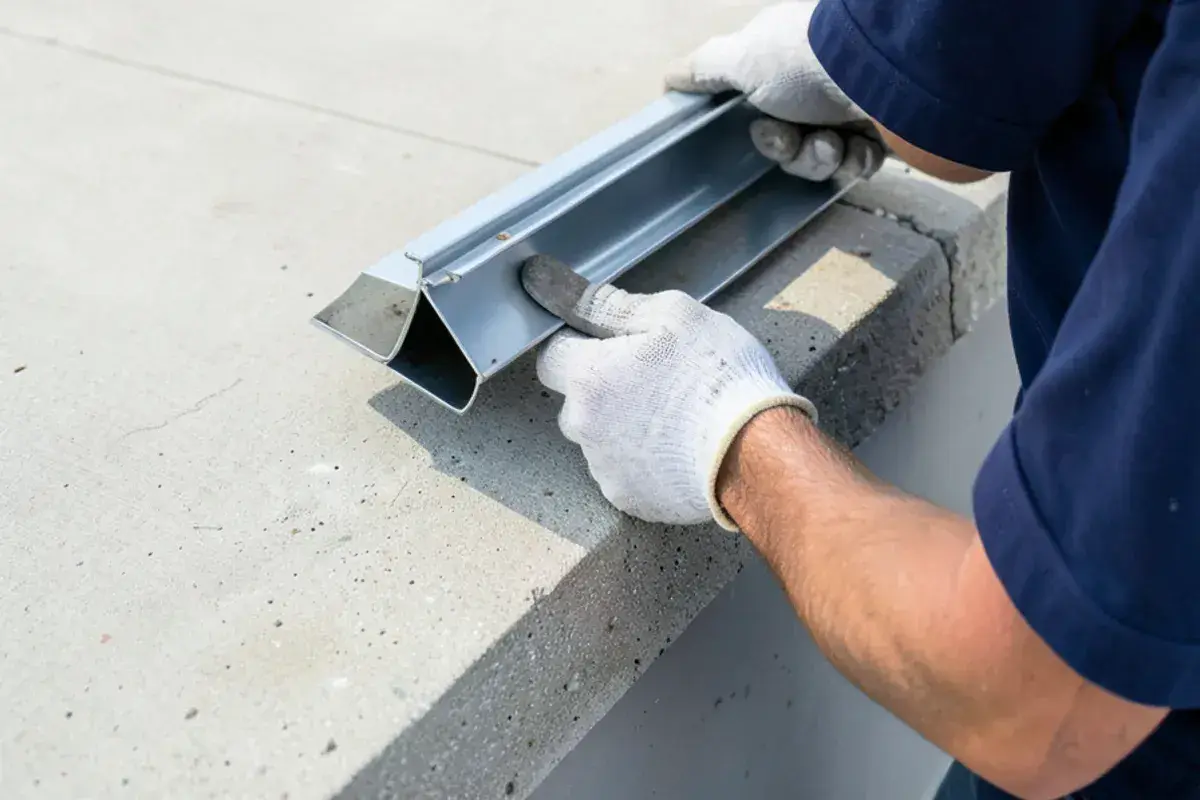
Often it will not, so measure before you order. Footprints, duct openings and weights change between generations. You have two options, and each one has a cost beyond the sheet metal.
| Option | Good for | Watch for |
|---|---|---|
| Curb adapter | Sound curb, keeping roof work small | Added height, duct transition losses, condensate and gas connections moved |
| New curb | Rotten or undersized curb, or a large footprint change | Roof tear-in, flashing, roofer coordination, longer shutdown |
An adapter adds airflow resistance. The Energy Code’s fan power table gives an adapter curb allowance for multi-zone VAV systems and none for other fan systems, so have the transition checked and do not assume the old airflow carries over.
Weight deserves its own check. A heat pump or a unit with added sections can outweigh what it replaces. Ask your building department what triggers structural calculations and what it wants for anchorage. If the roof is under warranty, bring the roofer in early, since new penetrations and flashing can affect that coverage.
Height can matter too, especially with an adapter under the unit. South Gate’s Chapter 11.25, written for residential neighborhood zones, requires rooftop mechanical equipment to sit behind a permanent parapet and be screened from view. We could not confirm the wording for commercial zones, so ask the Planning Division before you order a taller unit.
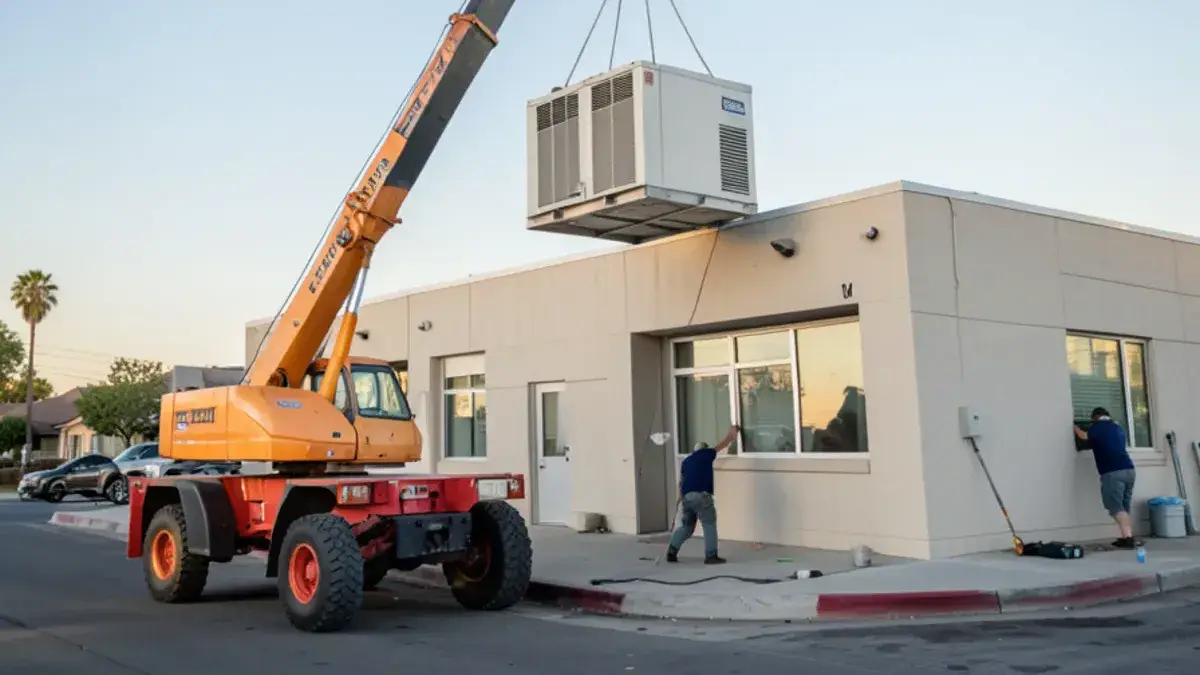
What should a crane plan cover?
The crane day has the least room for surprises, so settle these points in advance.
- Confirm the unit weight and the rigging points from the manufacturer.
- Measure the reach from the crane position to the curb, and check for overhead lines.
- Ask the crane company for the current certificate. Cal/OSHA Section 5021 calls for annual certification on equipment over three tons.
- Confirm the operator certification that applies to that crane.
- Check how old and new units will be rigged, and where the old one will land.
- Plan a fallback date for wind or a late delivery.
If the crane, a truck or traffic control takes up the street or sidewalk, ask Public Works what it needs. South Gate has an encroachment permit application on its website, and Cudahy lists Public Works for encroachment permits. If your building is in Cudahy, Building and Safety handles the mechanical permit. In South Gate, that is Building and Safety at (323) 563-9549.
How do you keep tenants informed?
Tenants forgive a planned shutdown far more easily than a surprise one. Give written notice, and check each lease for notice terms and access rules.
- Timing: name the date, the hours and the backup date.
- Cooling loss: say which spaces lose air and for how long. Offer temporary cooling for server rooms or sensitive stock.
- Power and gas: warn tenants if a shutoff affects anything beyond the unit.
- Parking: mark closed stalls and truck routes a day before.
- Noise and odors: roof work and sealants can reach a tenant space through the outdoor air intake.
- After hours: ask any contractor up front which hours its crew can work.
What affects the budget, and what should you keep?
Equipment is only part of the number. Crane time, curb work, structural review, electrical changes, permits, acceptance tests and any duct sealing all add to it, and a bid that skips them is not comparable. If the old unit has to hold on until the swap, commercial HVAC repair can buy that time. If you are still deciding when to act, your maintenance records show which units are costing you the most.
When the job closes, keep the signed-off permit, certificates of acceptance, warranty terms in writing, startup readings, filter sizes and the economizer settings. Add the new unit to your log, and set up scheduled maintenance from the first season. Our rooftop unit service page covers repair and upkeep on units you are keeping.
Pick the date before the unit picks it for you
A planned change-out gives you the curb, the permit, the crane and the tenants in the right order. A failure in late summer gives you whichever unit a supplier has that week. Pull the nameplate photos now, rank the units and get the compliance path confirmed. Then call us. We will look at the old unit and the curb, explain what we find and give you a clear, upfront quote that lists the scope line by line.
Sources
- U.S. Department of Energy: What is the No. 1 way to save money on your rooftop unit?
- City of South Gate Municipal Code: Chapter 11.25
- California Energy Commission: 2025 NRCC-MCH-E Mechanical Systems
- California Energy Commission: Restructured 2025 Energy Code (for information only)
- California Energy Commission: What is new for 2025, nonresidential
- California Energy Commission: 2025 Economizer FAQs
- California Energy Commission: Acceptance Test Requirements
- California Energy Commission: FDD quick reference
- Cal/OSHA: Title 8, Section 5021
- City of South Gate: Encroachment Permit Application
- City of Cudahy: Permits
- South Coast AQMD: Rule 1111 and Rule 1121
Rooftop Unit Replacement questions
Can I replace a rooftop unit with the same model in South Gate?
Sometimes, but do not assume it. Under the 2025 Energy Code, a replacement unit has to meet current requirements, and a unit under 65,000 Btu/h in many building types has its own table of options. Older models may not qualify. Confirm the path with South Gate Building and Safety, or your own city, before ordering equipment.
How far ahead should a building owner plan a rooftop unit replacement?
Start as soon as the unit shows repeat failures, and well before peak cooling season. The time goes to equipment selection, plan check, curb and structural review, and crane scheduling, and each one depends on your city and supplier. Ask your contractor for a schedule that names each step, and keep a repair option open for the old unit in the meantime.
Should I replace every rooftop unit on a building at the same time?
No, not automatically. Replace the units whose records justify it, and keep the sound ones running. Grouping two or three aging units on one crane day can cut repeat lifts and tenant shutdowns, so price it both ways. Each new unit still needs its own compliance path, curb check and acceptance test, and that paperwork should be listed unit by unit.
Have a rooftop unit near the end of its life?
Call Proair for a clear, upfront quote. We are open Monday to Saturday, 9 to 5.
- CSLB C-20 #776028
- 4.8 from 16 Google reviews
- Shop in USA Business Park
- Open Mon to Sat, 9 to 5
Helpful reading
Areas we serve